
In the I of the Storm
The Wizard of Oz at the Sphere, reviewed from inside

Our state changes what feels true
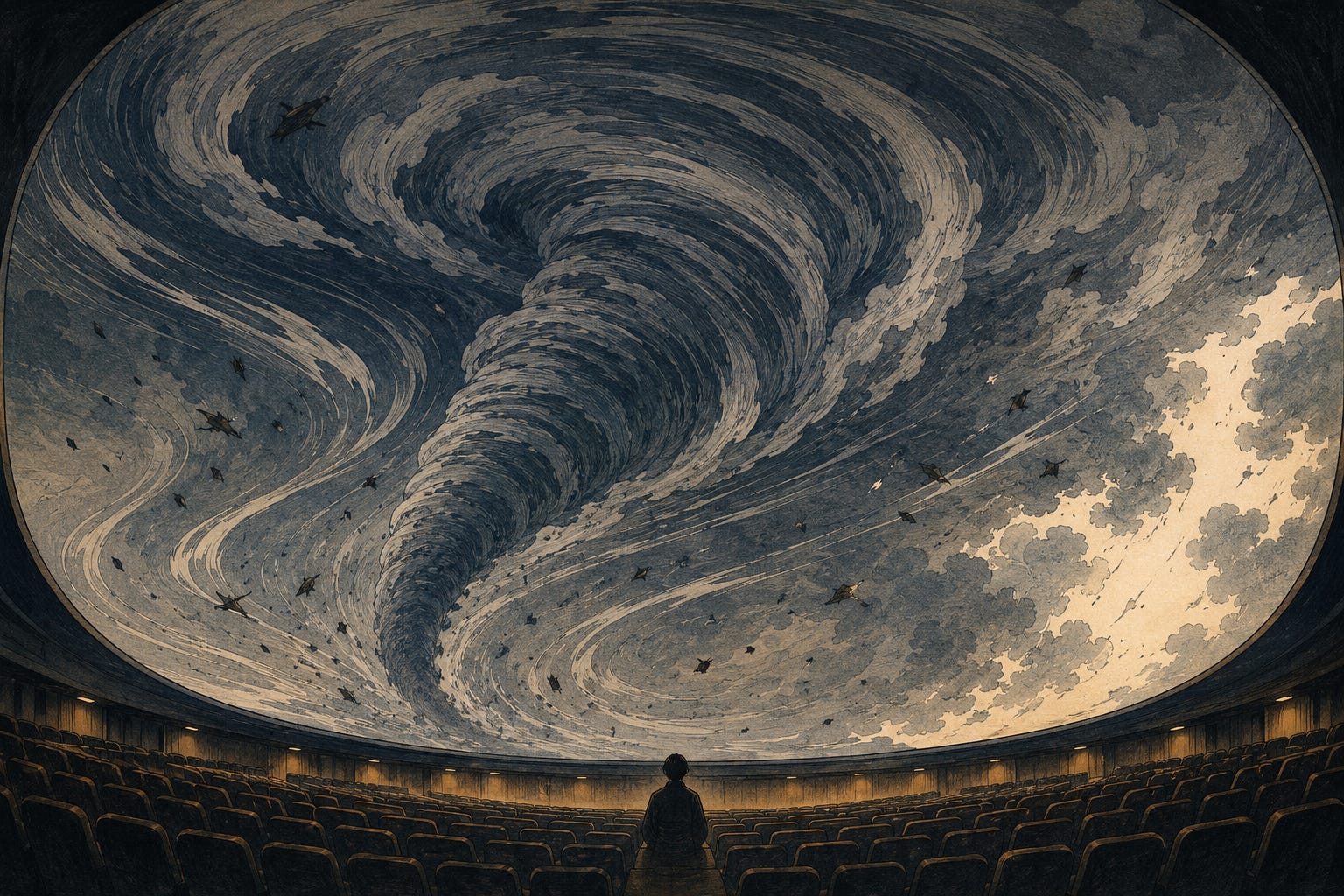
I was back in Vegas at The Venetian for a conference and decided to skip the casino floor and watch Wizard of Oz instead at the Sphere. A colleague had spoken highly of it. The Sphere’s seats shake for real, the wind machines push actual air through the auditorium and the screen wraps the storm around you until there’s no edge left to look away to. Sixteen storeys of Kansas sky, and me somewhere inside it, having paid a premium for exactly this. I’d clapped during the first act, actually clapped, alone in my seat, at nothing in particular except delight, which is not a thing I do. I wasn’t in Kansas any more.
Then the storm came and took the delight with it.
What arrived instead had nothing to do with Kansas. Work arrived. A tightness across the shoulders arrived. My mind was back in New York. And underneath both, an old feeling that has been arriving since long before I had a career to attach it to: what you’re doing is not enough. So I sat in the most technologically extravagant theatre on earth, watching a children’s story about a humbug wizard, while my chest was executing instructions written decades ago. I could see it running, but that seeing didn’t have an option to tune to a different station. The pattern was determined to run to completion, and it picked up passengers as it went: dissatisfaction with the film, an armchair critic’s itch about the adaptation, a thin frustration at being someone whose fun last solo night in Vegas after a conference had turned into this. Each inner frown felt like a fresh, independent judgment. Like that feeling when you’ve had one glass of wine too many on a Sunday afternoon, and you wish you could go back to Start and begin the game again.
The film ended the way it always ends, with Dorothy choosing grey Kansas over Technicolor. I walked back along the Venetian’s fake canal, under its fake sky, and somewhere between the canal and the hotel lift the evening reorganised itself into a single observation: the delight in the first act and the dread that followed were the same kind of event. Both arrived uninvited, produced by conditions I hadn’t chosen and mostly couldn’t see: the sound design, the shaking seat, how little I’d slept, my own history. Both passed, and neither one was a verdict on the film, the evening, or me. They were weather, and I’d spent most of the film mistaking the weather for news.
The thought I carried back to my room was simple, and it’s the point of this whole essay: every judgment is a reading from an instrument that has a state. By state I mean the temporary condition of body and mind at the moment of judging: the mood, the fatigue, the attention, whatever expectations and history happen to be awake. That doesn’t make judgments false; it means they need calibration. Which is why any review I wrote that night would mostly have been a review of me. Two different versions of me watched the same film, the jubilant one who clapped in the first act and the tense one who sat through the storm, and they came away with verdicts so different I couldn’t reconcile them even from the inside. It was disconcerting, like watching two strangers share a seat. The loop runs like this. Conditions shape my state. My state shapes what I notice. What I notice shapes what gets stored and rehearsed. Those traces help build the next version of me, which judges and acts, creating the next set of conditions. I’ve been writing about pieces of that loop for the last year without seeing that they close [→ The Trace] [→ The Sky Painting Robot] [→ Half Past One]. This essay is my attempt to see it whole, assuming you’ve read none of the others.
Start with memory, because the science there is oldest and strangest. In the 1930s, the Cambridge psychologist Frederic Bartlett gave English students an unfamiliar folk tale called The War of the Ghosts and asked them to retell it, repeatedly, over days and months. The story didn’t fade the way a photograph fades; it mutated. Canoes became boats. Seal hunting became fishing. The parts that were unfamiliar to an English student quietly disappeared, and what remained was reshaped until it resembled a story such a student might plausibly tell. Bartlett’s conclusion was that remembering isn’t playback. Each act of recall rebuilds the memory from surviving traces, under present conditions, using present materials. Modern research has strengthened the broader picture without settling it: under some conditions, recalling a memory appears to make it briefly open to revision before it stabilises again, though how far this explains ordinary human remembering is still debated. The safe version is enough here: the past we remember is partly assembled in the present.
The next step is an inference, not something Bartlett proved. If remembering is reconstruction, then a recurring idea is not simply being replayed. The mind produces it again, from the traces earlier occurrences left behind, under whatever conditions exist now. So when an idea keeps returning, insisting, feeling more true each time, recurrence tells me first that my mind can produce the thought again under these conditions. It doesn’t tell me the thought is good. An anxious thought may return because it’s threatening, and threats are difficult to ignore. A business idea may recur because I’m excited, or under-slept, or because the environment keeps supplying the same cue at the same hour. Or because it genuinely fits reality, and reality keeps confirming it. From inside, at the moment of arrival, these can feel much the same; the conviction that this keeps coming up for a reason feels the same either way. Recurrence just buys the idea the chance to make the shortlist. And not all shortlisted ideas make it through to the end.
Attention compounds all of this. What I repeatedly attend to becomes easier to notice and to reconstruct later. This is why rumination feeds itself: every rehearsal of a grievance supplies more material for the next rehearsal. The same process deepens a skill, a friendship, a curiosity, a fear, without caring which. Buddhist practice has long treated attention as ethically consequential rather than merely useful, and this is why: what I keep returning to helps shape the mind that meets the next moment. The mind I’ll have next year is partly a record of what I let this year’s mind dwell on.
The thing I’m only starting to grasp, now and again, on and off, and which the storm demonstrated more efficiently than any argument could, is that the self doing the dwelling is itself rebuilt, continuously, from the same kinds of materials: memory, perception, expectation, other people’s responses, including the body’s ongoing report on its own condition. You can feel the difference. A thought usually arrives as content: there’s that idea again, held at some distance, examinable, mine but not me. A strong feeling arrives differently, as the condition I’m in. The dread in the storm didn’t present itself as a thought about inadequacy passing through awareness, available for inspection. It presented as me, as the plain fact of not being enough, self-evident the way a room’s temperature is self-evident, colouring everything else in the theatre, including my opinion of the cinematography. Feelings don’t visit the self the way thoughts do; they’re among the materials the self is being rebuilt from. The storm didn’t give me an emotion. For about forty minutes, it gave me a slightly different person.
Now look for a supervisor outside all this, the one who directs attention, approves each memory and signs off every judgment, and, as all the books warned me, I can’t find one. Attention moves, memories assemble, verdicts form, actions begin, and the sense of being their author appears to be part of the process rather than something standing beyond it. There are two easy directions to take this, and I don’t trust either. I don’t mean anything mystical by this: nothing in the storm was mystical, it was wind machines and an old habit doing what they do. And it isn’t fatalism, because agency survives; it just doesn’t live where the supervisor was supposed to sit. I couldn’t stop the dread from arriving. By the time I noticed it, it was already there. What stays open is everything else: sleep, inputs, environment, company, what I practise attending to, and, above all, when I make decisions. Self-control turns out to be less like willpower in the moment and more like statecraft over time: arranging the conditions under which the next version of me will have to act.
Which returns us to the instrument, and to what calibration actually means. Las Vegas that week was 44 degrees Celsius; whatever I judged there, I judged inside that. A much-cited study from 1983 offers a memorable demonstration of the problem, or seemed to. Norbert Schwarz and Gerald Clore telephoned people on sunny and rainy days and asked how happy and satisfied they were with their lives. In the original experiment, people called on rainy days reported lower happiness and life satisfaction, unless the interviewer first mentioned the weather. Once the feeling had an obvious source, it no longer seemed to count as information about life as a whole. There’s a catch, and it matters for an essay about calibration. A much larger later study of more than a million Americans found no reliable general relationship between daily weather and life satisfaction. It wasn’t a direct replication, but it’s enough to stop me treating the original finding as settled. So I can’t use the experiment as proof that clouds routinely rewrite people’s verdicts on their lives, and I can’t blame the desert heat for mine. What survives is the question: when a feeling enters a verdict, how much belongs to the object, and how much belongs to the person judging it?
And to be clear about what I’m not saying: this is not an argument that every verdict is arbitrary. An instrument isn’t useless because it needs calibration. Some judgments are plainly better than others, and the difference is discoverable. A judgment becomes more trustworthy when it survives a change in state: a night of sleep, a different mood, standards fixed before the mood could bend them, examination by someone with different incentives. Two decades of product work taught me a version of this before I had words for it. An A/B test is a better instrument than my gut, but it’s still a reading: of those users, in that season, on that version of the product, against whatever else was happening that week. Too often, we ship the winning variant and never ask whether it would win again under different conditions. We call a single reading knowledge. The decisions I’ve regretted were rarely the wrong analyses. They were readings taken once and never taken again. The goal isn’t perfect objectivity. It’s a reading that holds across more than one condition. Calibration means deciding the standards in advance, letting time pass and the state change, and, where it matters, asking someone who didn’t make the thing to grade it. Peer review, standards fixed in advance and sleeping on it are versions of the same move at different scales: don’t let the excited state be the only state that decides.
For the record: I formed an aesthetic judgment of The Wizard of Oz that night, somewhere in the third act, and it was withering. Two days later I can’t tell you whether the film was any good. I regard that as the correct amount of knowledge. I filed it under “unique and interesting experience”.
Practising mindfulness has taught me one unglamorous thing about all this: seeing a pattern doesn’t stop it. The change, when it comes, is smaller and less cinematic. The pattern gets noticed sooner, identified with a little less completely, released a little faster. And the seeing itself turns out to be nothing special: no fireworks, no arrival, no upgraded person walking out of the dome. Subtle, plain, and like it’s nothing, which is its own frustration, because some part of me kept score all evening and wanted the insight to count as an achievement the way the storm counted as an experience. That scorekeeper is part of the machinery too. It’s keeping score of this paragraph. And I’ve learned that trying too hard to let it go is counterproductive. Rather, you just need to notice it. As if from a distance.
Which brings me to the irony. This account that my mind was so eager to write down was assembled in a hot state. It came together in the hours after an intense aesthetic experience (probably the most intense artificial tornado I will ever experience), in a mind primed by years of looping to find exactly this shape, and it arrived with the specific pleasure that pattern-finding brings me. Someone who knows me well has learned to distrust that pleasure; he’s watched me reach for a frame whenever a feeling lands, the way other people reach for their phones. So the essay you’ve just read is, by its own argument, a suspect document: a verdict-shaped object produced by an instrument in a known state, claiming, with felt conviction, that felt conviction isn’t evidence. I’ve tried to treat it the way it says such things should be treated. The claims were written down that night in Vegas, in one sitting, hot. The standards for judging them were fixed before I was allowed to reread them. Then I gave the draft to an AI model with instructions to attack the claims rather than admire the prose. It hadn’t been in the dome and had no chest to tighten. That doesn’t make it an objective judge; it carries its own biases and a tendency to accept my framing too readily. But it’s a different instrument, reading in a different condition, and that’s about as much calibration as one mind can buy on short notice. The draft failed its first review on the exact grounds it proposes: overclaiming, conviction outrunning evidence, the author enjoying his vocabulary more than his reader. What you’re reading is the corrected version, and it stays provisional for as long as I can stand it, which the scorekeeper informs me is not indefinitely.
I’d like this account to be true. That liking is one more feeling, produced by conditions, asking to be trusted. Maybe the storm showed how important discipline is around this. Maybe it’s the storm still running, wearing a lab coat now. I can’t decide between those by asking which one feels truer. I can only see what remains when the weather changes. And one thing I know to be true above all else: eventually, the weather always changes. Everything does.