
The Empty Chair
On dead snakes, whirlpools, and who does the jumping

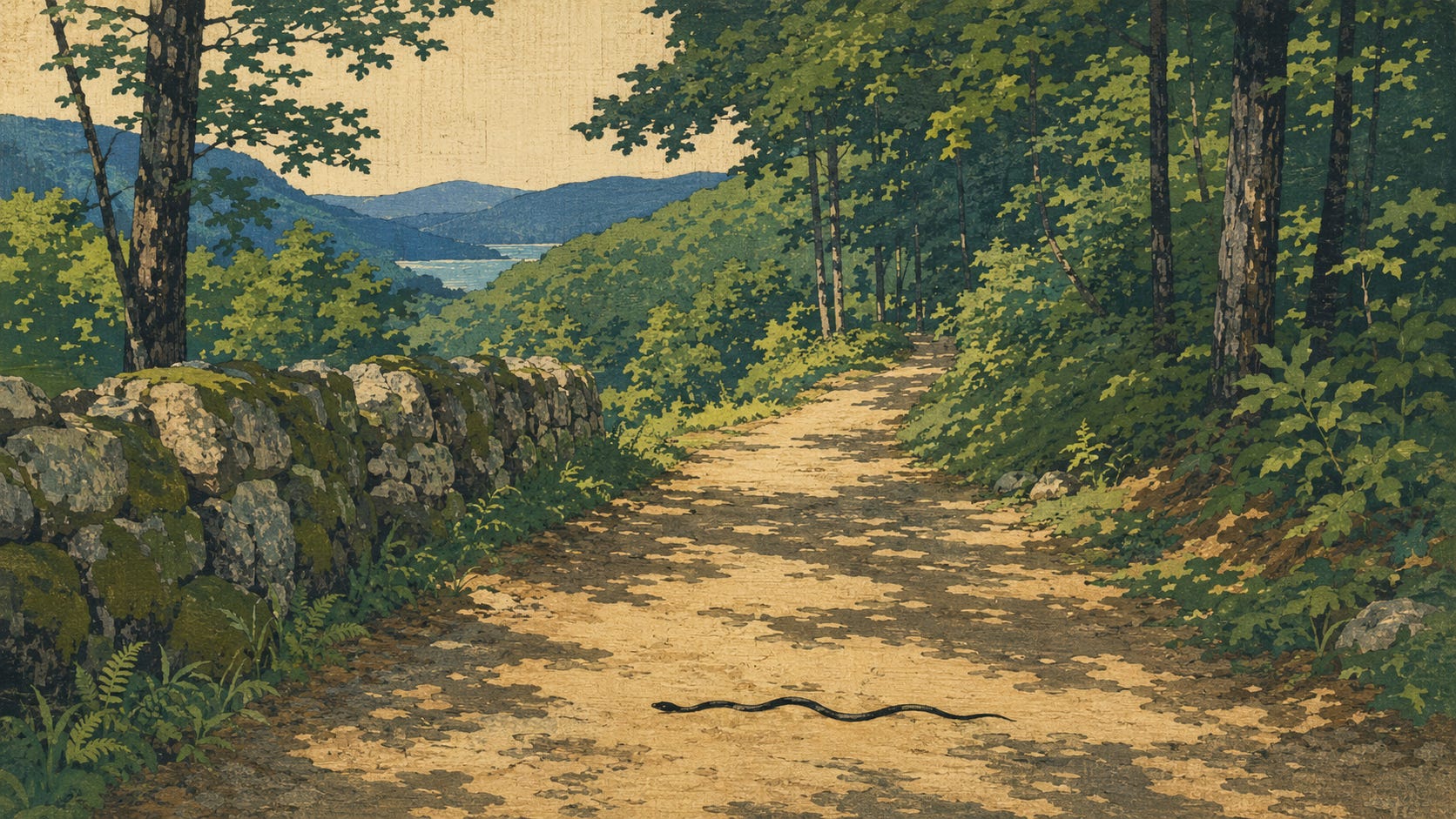
Late last week a dead snake stopped my morning run. It was lying across the road, and I wasn’t paying attention, looking up at the trees, so I only saw it when it was right in front of me. Before I could register that it was dead, the adrenaline was already through me and I’d thrown myself sideways. I stood there with my heart pounding at a snake that had clearly been dead a day or two. It made no difference to my body at all. The adrenaline took so long to clear that I gave up and walked the rest of the way home, feeling both silly and a little annoyed.
In my defence, snakes are not my favourite animal. I have a bit of a troubled history with them.
Some of it is just geography. Being South African, you grow up seeing snakes everywhere. People who have never been to Africa sometimes imagine lions in the streets. I’ve honestly been asked this more than once. If that was your impression, I’m sorry to disappoint you, there are no lions or elephants roaming the neighbourhood. What we do have is snakes, spiders and scorpions that can genuinely kill you. Australians may be able to sympathise.
And some of it is personal. One of my earliest memories: it was the early eighties, long before anyone had heard of helicopter parenting, and I was three or four, in Ladysmith in KwaZulu-Natal, alone out in the garden, where I found my way into the chicken coop to feed the kapokkies. As I picked up the water bowl, I saw a rinkhals coiled underneath it. A rinkhals is a spitting cobra, and it did exactly that. It reared up at me, half my height from where I stood, if memory serves, and it spat. I got a massive fright, understandably, and ran inside. My mother flushed my eyes out with milk, this being decades before anyone could ask ChatGPT or Claude what to do in that sort of emergency. Only luck sent the venom clear of my eyes.
Looking back now, I can see how something like that shapes you in ways you don’t fully understand. Fast forward a few decades and I live in upstate New York, in the Catskills, where the number of snakes I see seems to climb every summer. It’s not that I have ophidiophobia exactly. I just see them everywhere. On Saturday morning a long black rat snake (harmless, I know) went sailing across the yard. In the afternoon, planting a Seven Son-Flower, I startled a small garter snake. Those are mostly the two we get.
I am, evidently, the sort of person who leaps at a dead snake and then builds a theory of mind out of it. So take all of it with a pinch of salt.
The snake on the road was real, even though it was dead, and my body didn’t wait to find out. It fired first and asked questions later, because that is its job. But here is the strange part. Most of the snakes I see aren’t real at all. A coiled hose, a bent stick at the edge of the garden, a shadow on the path, each one (briefly) a slang in die gras. I see one of those, the mental concept snake arrives, and almost always the adrenaline never comes. The body lifts a fraction, gets ready, and then quietly lets it go. The jolt it braced for doesn’t arrive.
It’s that small readiness I keep snagging on. The brace that goes off before there is anything to brace against. What is that, and whose is it? These questions (luckily) don’t keep me up at night, but I find them interesting, entertaining even. Because if you watch that brace closely, something odd shows up. It gets the body ready for a snake that isn’t there, holds the fear for half a second, and then lets it go, over and over, all day. And the more I watch it, the more I suspect it’s not something I am doing. It might be closer to what I am. Maybe the feeling of being a self is just this, a low constant lean, the body tipping into the next moment a beat before the next moment arrives. We spend most of our lives using what we remember to guess what is coming, and the guess has a posture. I’m coming to think that posture is the I.
I had always assumed there was someone in charge of all this. Someone in here the bracing happens to, who watches the guesses come in and does the deciding. It’s the most natural assumption in the world, and for the better part of four decades I never once checked it. When I finally did (sitting still long enough will do that), I couldn’t find anyone. The watching keeps happening, the bracing keeps happening, choices keep getting made, and yet when I go looking for the one it’s all happening to, I keep arriving at an empty chair. Things just happen.
Now, if someone tells you there is no self, the only sensible response is to back away slowly, so let me be careful about what I actually mean. I’m not saying you don’t exist. You are as real as a whirlpool (or a rinkhals!) is real.1 A whirlpool is not a thing the river carries along, it’s something the river is doing, a shape with an edge and a name. It’s completely real. It’s just not a separate object you could lift out and hold in your hand. That someone in charge is the whirlpool’s guess about what it is, and the guess is wrong. And when you stop believing the guess, you don’t lose yourself. You lose a mistake about yourself, and it comes as a relief.
People have been pointing at this for a long time. I’ve written about Nisargadatta Maharaj before. He used to send his students back, again and again, to the bare sense of I am. Not I am this or I am that, not the whole story of who you take yourself to be, just the plain wordless fact of being here. You don’t add anything to get there, and you don’t find anyone underneath it either. You let the bracing go quiet enough that it stops standing in front of the view, and what is left is not a second, truer self below the first. It’s the same lean, with no one found inside it.
Let’s be honest about how steady any of this is. It isn’t, at least not for me. I fall back into the old understanding constantly, someone in the chair, running the show, and it feels as natural as it ever did. But every now and then, halfway through an ordinary afternoon, the chair shows up empty again, and what surprises me is that it never arrives as a thought, it arrives in the body. The bracing eases, shoulders drop that I didn’t know were up, and for a little while there is nothing to defend. It comes as relief. Then it fades, the someone climbs back in, and that seems to be the rhythm of it for now.
If there’s no one behind my thoughts, and no one behind my attention, then is there someone behind what I do? Do I act, or does action simply happen through me? Am I an agent, or just a puppet?
It’s a false choice, and the whole trick is in the word or. The author standing outside the chain of causes, choosing from nowhere, was never there. To be the real source of myself I would have to be the cause of my own causes, and nothing is. So in that grand sense, no, I am not, and neither are you, and neither was anyone who ever lived. But that doesn’t leave me a puppet either. Take a sneeze and a sentence. Both are fully caused, neither floats free of what came before it, and yet they are plainly not the same kind of event. A sneeze happens to me. It bypasses everything I know and want, and I am as much a bystander to it as you are. There is a reason we say bless you and not well done. A sentence happens through me, through my picture of the world and my reasons and the weighing of one against another. That routing is the whole of agency. Not freedom from cause, but a particular kind of cause, the kind that runs through the self instead of around it. So no one is in the driver’s seat. But the driving still happens, and the driving is what I am, the same way the bracing was. I don’t have agency the way I have a coat. Agency is something that happens, and it’s mine in the only sense the word has ever really meant.
Which get’s us back to the road, where this started. The snake was dead, but my body fired the adrenaline anyway and threw me sideways, the way it’s built to, before I could check whether there was anything to fear. It fires first because the one time it’s right is the one time that could kill me. Most mornings there is no snake at all, and it braces all the same. That bracing, getting ready for threats that aren’t there, leaning into a tomorrow it can’t be sure of, is the closest thing to an I that I’ve ever found. It is not a thing. It is also not nothing. It’s a warm, caused, real lean into whatever comes next. Some days the chair behind it shows up empty. More often the someone is back, taking the credit. I haven’t worked any of this out, and I find I don’t mind. There will be more mornings on that road, and, this being the Catskills in summer, more snakes.
The whirlpool is most associated with Alan Watts, though it’s older than him: the Buddhist self-as-process, Heraclitus and his ever-changing river, and later cybernetics, where Norbert Wiener wrote in 1950 that we are not stuff that abides but patterns that perpetuate themselves, whirlpools in flowing water. I prefer it to the usual alternative, the wave that rises and falls back into the ocean, because wave language slides too easily towards merger, the suggestion that you were always one with the sea. The whirlpool keeps its own shape while being nothing but flow: individuated and real, and still not a thing you could lift out.